
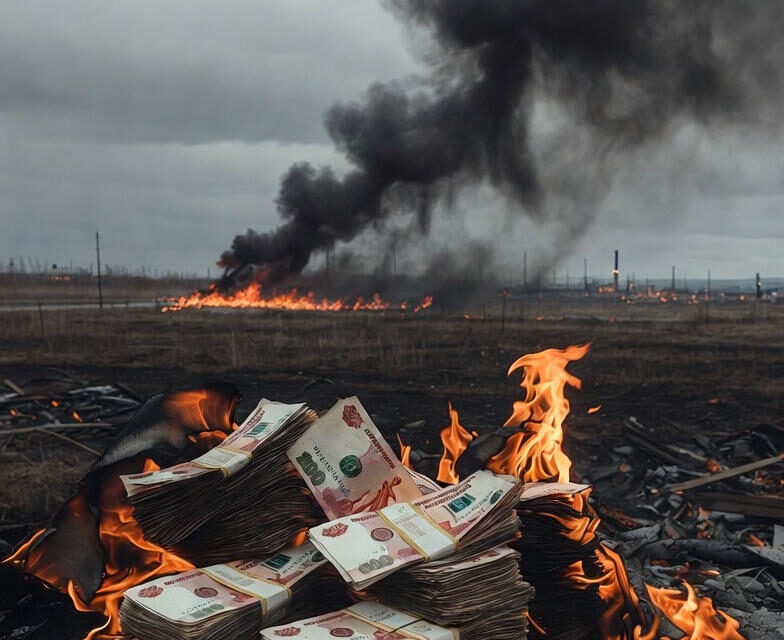
Russia oil and gas revenue is sliding at the very moment the Kremlin prepares its 2026 war budget, creating a growing financial headache for President Vladimir Putin. September’s takings from oil and gas are projected to fall by about 23% compared with a year earlier, as lower global prices and a stronger rouble erode the value of export earnings. For a state that still relies on hydrocarbons for up to a quarter of its budget, this drop directly threatens the cash pipeline funding Russia’s fourth year of full-scale war against Ukraine.
Oil and gas under pressure
In September, Moscow expects around 592 billion roubles (about $7.1 billion) in oil and gas income. That figure looks even weaker in context: revenue from January to September is on track to shrink by more than 20% versus the same period last year, underscoring how fragile Russia’s energy windfall has become.
On paper, September will still bring a 17% month-on-month increase in oil and gas revenue, but that bounce comes mainly from lower state subsidies to refineries, not from stronger fundamentals. Last year, oil and gas brought in 11.13 trillion roubles. Officials initially forecast 10.94 trillion roubles for 2025, then quietly cut the target to 8.32 trillion. The downward revisions show how much room Moscow has already lost.
Deficit, tax hikes and war costs
The Kremlin is responding to weaker Russia oil and gas revenue with old-fashioned tools: higher taxes and a bigger deficit. Personal income and corporate tax rates have risen in 2025, yet the government still had to triple its deficit forecast to 1.7% of GDP. Record military spending crowds out other priorities, forcing economic planners to juggle defence, social payments and regional support with fewer reliable petrodollars.
A slowing economy and hard 2026 choices
After surprising many by avoiding a deep recession in 2023–2024, Russia’s economy is now losing momentum. Official growth forecasts have been cut, and senior bankers and officials warn of stagnation or even a fresh downturn if current trends continue.
The finance ministry must present a draft 2026 budget to parliament by the end of September, just as the energy slowdown becomes impossible to ignore. A new budget rule, due to take effect next year, aims to shield state finances from swings in oil prices and Western sanctions. But no technical fix can fully replace shrinking hydrocarbon income while war spending remains at Cold War–era highs.
For Putin, the choice is stark: either sustain massive military outlays and accept deeper structural damage to the economy, or curb ambitions abroad to stabilise Russia’s finances at home. As Russia oil and gas revenue weakens, the cost of the Kremlin’s war strategy keeps rising.









 German
  English
  Ukrainian
  French
  Spanish
  Chinese