
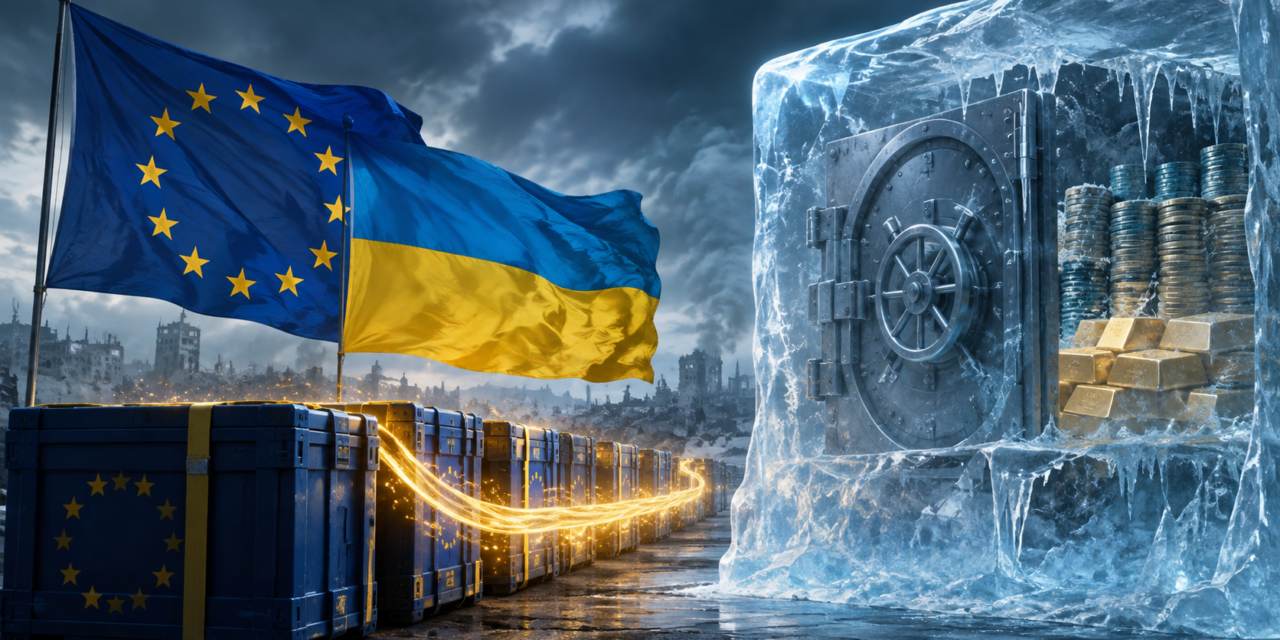
The European Union has agreed to provide Ukraine with a €90 billion loan intended to sustain the country financially and support its war effort against Russia over the next two years. Rather than financing the package directly from Russian state assets frozen in Europe, EU governments chose a simpler mechanism: borrowing on financial markets backed by the EU budget. The arrangement is expected to allow funds to reach Kyiv more rapidly and demonstrates that the bloc is prepared to assume a larger financial role as U.S. military support declines. Ukrainian President Volodymyr Zelensky had warned EU leaders that without new assistance, the country could face serious funding shortages within months. Although the agreement secured immediate support for Ukraine, it represented a retreat from the more ambitious proposal promoted by German Chancellor Friedrich Merz and European Commission President Ursula von der Leyen to create a reparations loan based on frozen Russian assets.
That proposal encountered strong opposition, particularly from Belgium, where most of the roughly €210 billion in Russian assets frozen within the EU are held. Legal, financial and political concerns surrounding the use of those funds prevented leaders from reaching agreement. Hungary also played a decisive role. Prime Minister Viktor Orbán had opposed both an EU-financed loan and the use of Russian assets, but ultimately accepted the borrowing plan on the condition that Hungary would not bear its financial costs. Slovakia and the Czech Republic also obtained exemptions. Orbán subsequently declared the reparations-loan concept effectively dead, although other European leaders maintained that discussions over the future use of Russian assets could continue.
The frozen funds nevertheless remain important. The EU has moved to keep them immobilised indefinitely, preventing their return to Russia without European approval and preserving them as potential leverage in negotiations over the war and Ukraine’s eventual reconstruction. Some EU leaders have suggested that the assets could later be used to repay the newly agreed loan, although such a move would revive many of the legal and political disputes that blocked the original proposal. The final agreement therefore represents both a significant commitment and a compromise. It ensures that Ukraine receives substantial and relatively rapid financial assistance while postponing the more contentious question of whether Russia’s frozen sovereign assets should ultimately finance Ukraine’s defence or reconstruction.
https://www.reuters.com/world/europe/eus-ukraine-funding-deal-keeps-kyiv-fight-russian-assets-deep-freeze-2025-12


 Spanish
  English
  Ukrainian
  French
  German
  Chinese