
Poland Activates Article 4 as NATO Responds to Escalating Drone Incursions
Poland NATO Article 4 drones became a central topic of urgent international attention after Warsaw activated the treaty clause in response to a coordinated series of Russian drone violations. The dramatic escalation unfolded overnight, marking the first time since Moscow’s full-scale invasion of Ukraine in 2022 that Russian aircraft deliberately crossed into Polish airspace directly from Belarus. Polish forces tracked 19 crossings, intercepted multiple drones, and immediately raised the military’s readiness to its highest level.
A First for NATO Air Defenses
The situation triggered unprecedented action: NATO aircraft from Italy, the Netherlands, and Germany engaged hostile drones inside allied airspace for the first time. According to NATO’s Supreme Headquarters Allied Powers Europe (SHAPE), the rapid multinational response showcased the alliance’s readiness and unity under escalating pressure from Russia.
(Source: www.nato.int)
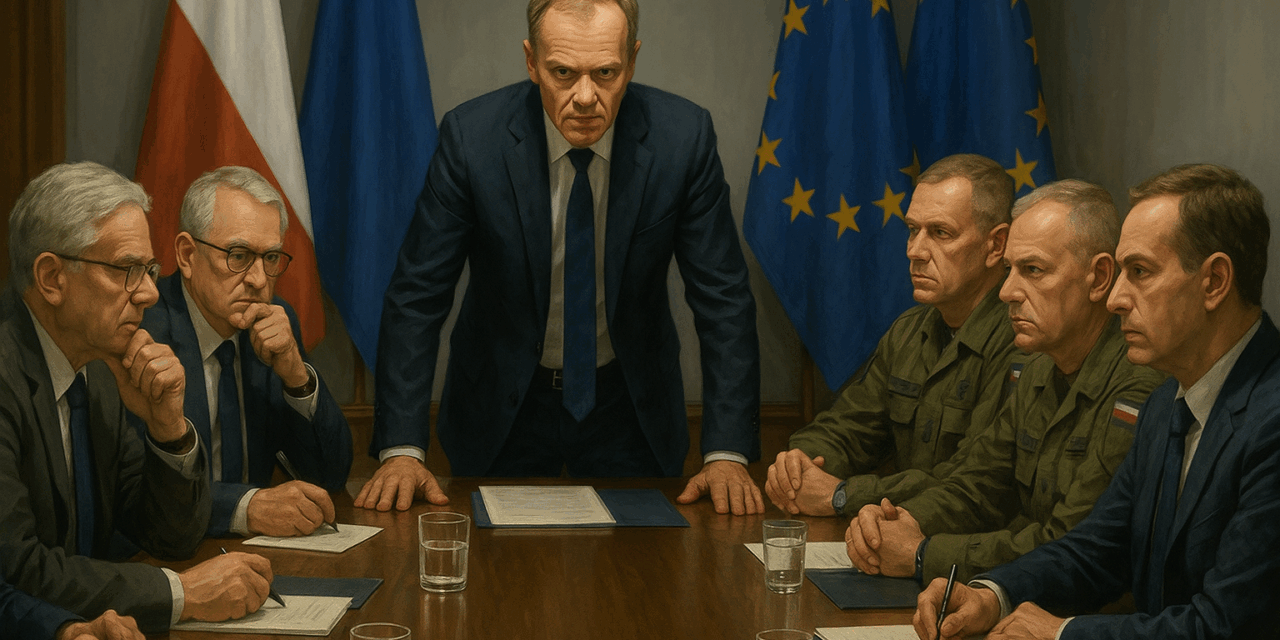
Prime Minister Donald Tusk convened an emergency cabinet meeting and emphasized that this was not an accidental violation or minor provocation. Instead, it represented a direct threat to Poland’s territorial security. Tusk coordinated with President Karol Nawrocki and immediately requested Article 4 consultations, a mechanism used when a member perceives imminent danger.
(Source: www.gov.pl)
European Airports Halt Operations
The drone activity forced several airports—including Warsaw Chopin, Modlin, Rzeszów-Jasionka, and Lublin—to suspend flights temporarily. Local police also recovered drone debris in Czosnówka near the Belarusian border, further confirming the scale of the incursion.
Strong International Reaction
NATO Secretary-General Mark Rutte condemned Russia’s “reckless behavior,” highlighting that the alliance is monitoring its eastern flank with heightened vigilance. European leaders, including France’s Emmanuel Macron, echoed full solidarity with Poland, stressing that Moscow must halt its escalation and respect allied airspace.
Meanwhile, Tusk engaged leaders across northern Europe—Finland, Denmark, Norway, Sweden, and the Baltic states—all of whom shared concerns about rising Russian aggression. With F-35s, F-16s, Mi-17s, Mi-24s, and a Black Hawk deployed during the interception, Poland demonstrated both preparedness and resolve.
As tensions rise, NATO’s unified military and political response sends a clear message: the alliance is prepared to defend every inch of its territory against Russian provocations.




 French
  English
  Ukrainian
  German
  Spanish
  Chinese