

The Russian disinformation campaign in Europe has entered a new and more deceptive phase. A major investigation has revealed that Russian intelligence services orchestrated a covert operation in Vienna and other European cities while posing as Ukrainians. The goal was to undermine trust in Ukraine and weaken European public support at a critical stage of the war.
A Coordinated Operation Behind a False Ukrainian Image
In March 2025, Austria’s State Security and Intelligence Agency exposed a large-scale influence operation designed to manipulate public opinion against Ukraine. Subsequent investigative reporting by profil, Süddeutsche Zeitung, NDR, and WDR uncovered a broader European dimension. The documents show a decentralized Russian operation deliberately engineered to appear spontaneous and locally driven.
At the center of the operation was Jan Marsalek, the former Wirecard executive who fled Germany after the company’s collapse and has long been linked to Russian intelligence. According to investigators, Marsalek coordinated actions in multiple European cities, with Vienna serving as the primary testing ground.
Weaponizing Extremist Symbols to Damage Ukraine
Investigators documented how Russian operatives produced and distributed stickers and graffiti featuring neo-Nazi and far-right imagery combined with Ukrainian national symbols. These materials were designed to falsely associate Ukrainians with extremist ideology. Visual references included modified Wolfsangel symbols, yellow-and-blue color schemes, and slogans meant to provoke public outrage.
The campaign intentionally targeted historically sensitive environments. Vienna, and later German cities, were chosen because of their heightened awareness of fascist symbolism. The goal was not persuasion but emotional shock, designed to generate fear and mistrust.
Fake “Azov” Websites and Digital Amplification
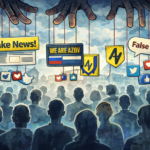
Beyond street propaganda, the operation expanded into the digital domain. A network of websites was created to impersonate European branches of Ukraine’s Azov unit, including multilingual domains aimed at French- and German-speaking audiences. These sites were promoted through physical graffiti and stickers to simulate organic grassroots support.
According to intelligence materials, Marsalek described the project as “subversive” and acknowledged direct discussions with Russia’s Federal Security Service. The strategy relied on scale and repetition rather than credibility, using both physical and online space to reinforce false narratives.
A Cold War Tactic, Modernized
Experts note that the tactic itself is not new. During the Cold War, Soviet intelligence painted swastikas in Western Europe to disrupt political cooperation. What has changed is the multiplier effect of digital platforms. Physical disinformation now feeds online outrage, accelerating the spread of false perceptions across borders.
By influencing public opinion, Russian intelligence aims to weaken political consensus, reduce military and financial support for Ukraine, and pressure European governments to reconsider energy and security policies.
Why This Campaign Matters Now
The exposure of this operation highlights how Russia adapts old psychological warfare methods to modern hybrid conflict. By posing as Ukrainians, Russian agents attempted to fracture European solidarity from within. The findings underscore the importance of vigilance, media literacy, and coordinated intelligence responses across Europe.
Sources
-
Ukrinform – Investigation summary and reporting
https://www.ukrinform.net -
profil (Austria) – Joint investigative reporting
https://www.profil.at -
Süddeutsche Zeitung – European intelligence investigation
https://www.sueddeutsche.de -
NDR / WDR – German public broadcasters
https://www.ndr.de
https://www.wdr.de



 Chinese
  English
  Ukrainian
  French
  German
  Spanish