
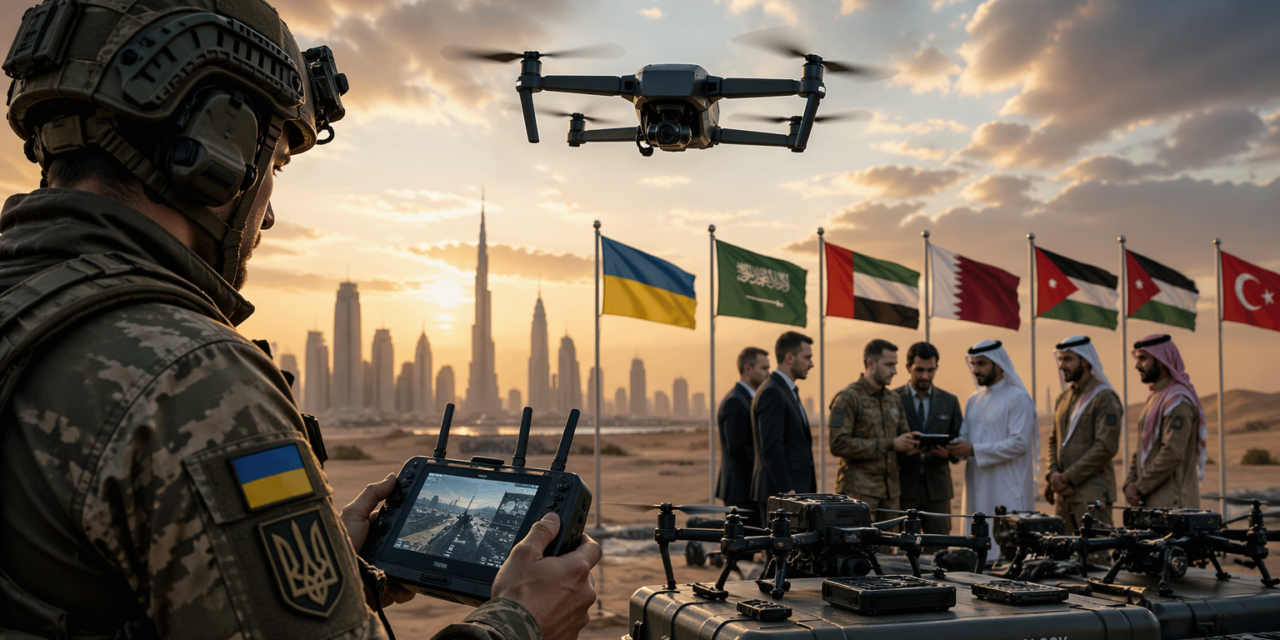
Ukraine is rapidly transforming its wartime technological experience into a strategic international asset, as President Volodymyr Zelenskyy announced growing global interest in the country’s drone capabilities. According to his recent remarks, at least 11 countries have already expressed interest in cooperating with Ukraine on drone technologies, signaling a shift in Kyiv’s role from a defense recipient to an emerging defense exporter and partner.
Central to this initiative is a framework often referred to as a “Drone Deal,” which is expected to include around ten separate agreements covering both arms exports and joint production. Ukraine is not limiting itself to simply selling equipment; instead, it is pursuing co-production models that involve establishing manufacturing facilities both within Ukraine and in partner countries. These collaborations will also extend to joint research and development, with international partners contributing investment and benefiting from Ukrainian battlefield expertise.
The demand for Ukrainian drone solutions is particularly strong in regions such as the Middle East, the Gulf, and the Caucasus. Ukraine’s recent diplomatic outreach reflects this trend, with Zelenskyy conducting multiple high-level visits across the Middle East, including Saudi Arabia, the UAE, Qatar, Jordan, Türkiye, and Syria. These engagements have already resulted in long-term agreements, some spanning up to a decade, focused on defense and energy cooperation.
Ukraine’s appeal lies in its unique operational experience. Facing an unprecedented scale of drone warfare, including approximately 19,000 aerial attacks during the winter of 2025–2026 alone, Ukrainian forces have developed advanced counter-drone systems. These include domestically engineered interceptor drones and tactics that have achieved interception success rates exceeding 89%. This real-world expertise has become a valuable export, with over 200 Ukrainian specialists already deployed abroad to assist allied nations in strengthening their air defense capabilities.
European partners such as Germany, Italy, Norway, Sweden, and the Netherlands are already engaged in this cooperation, alongside established ties with the United Kingdom and France. Ukraine’s approach emphasizes mutual benefit: it offers its hard-earned knowledge and technologies while securing financial investment and strengthening geopolitical alliances.
At a broader level, Zelenskyy has framed this initiative as part of a collective response to global security threats, particularly those linked to Iranian drone proliferation. By positioning itself as both a security provider and an innovator, Ukraine is redefining its place in the international defense landscape while leveraging the lessons of war to build long-term partnerships.









 English
  Ukrainian
  French
  German
  Spanish
  Chinese