
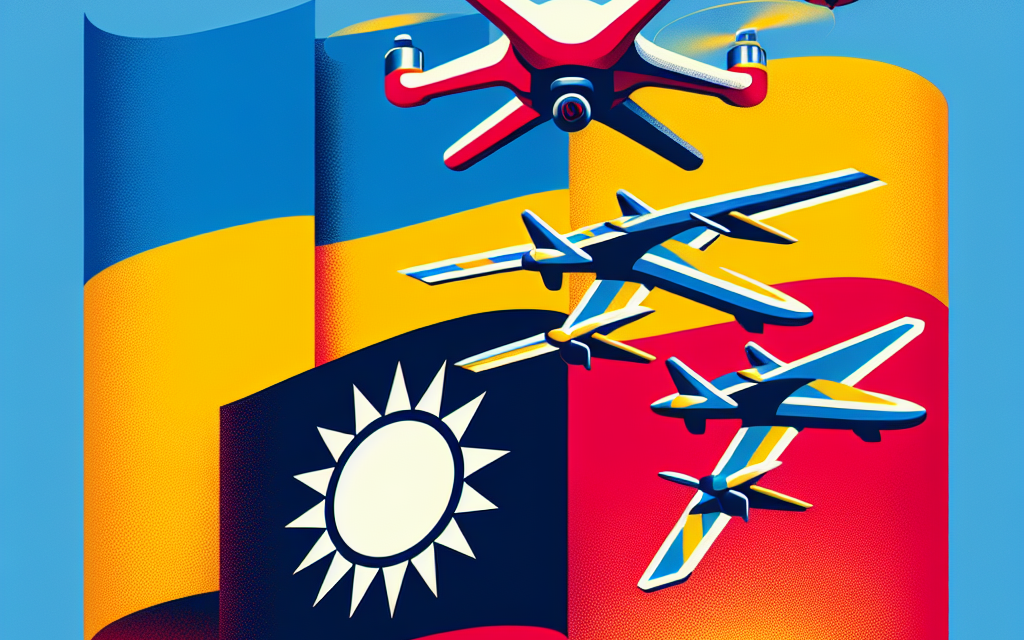
As Ukraine’s conflict with Russia persists, drones have become essential tools in modern warfare. Initially reliant on Chinese components, Ukraine now seeks to diversify and strengthen its supply chain by forging partnerships with Taiwan, known for its technological prowess in microelectronics and navigation systems. Although Ukraine aims to minimize dependence on Chinese suppliers, the availability and affordability of Chinese components make an immediate shift challenging. Despite these hurdles, Taiwan’s drone exports to Europe, particularly Poland and Czechia, have surged, serving primarily as intermediaries for Ukraine.
Taiwan’s government advocates for a self-sufficient defense industry, aiming to create a ‘non-red’ supply chain by tapping into its strengths in semiconductor and electronics integration. Ukrainian drone companies are adapting by increasing local production and tailoring systems for specific wartime needs. They face challenges such as cost competitiveness with Chinese products and the need for massive production capabilities. Additionally, geopolitical complexities arise, as Ukraine does not officially recognize Taiwan. Consequently, cooperation largely occurs through indirect channels without formal government collaboration.
Nevertheless, Taiwan exhibits nimbleness by establishing local offices in Europe and signing agreements with multiple countries to promote its industry. Both Ukrainian and Taiwanese entities express commitment towards this partnership, which holds the potential for deeper collaborations, particularly with the increasing demand for AI-driven systems. Taiwan has pledged to fund technological advancements to aid this effort.
For Ukraine, the search for robust, efficient supply chains is driven by the imperative to survive rather than market dynamics. Taiwan’s burgeoning role illustrates a strategic move away from Chinese dominance in UAV production, fostering new alliances in a shifting global landscape. Navigating geopolitical tensions and ensuring affordable, large-scale production remain key challenges in this evolving partnership.
Source: The Guardian



 English
  Ukrainian
  French
  German
  Spanish
  Chinese