

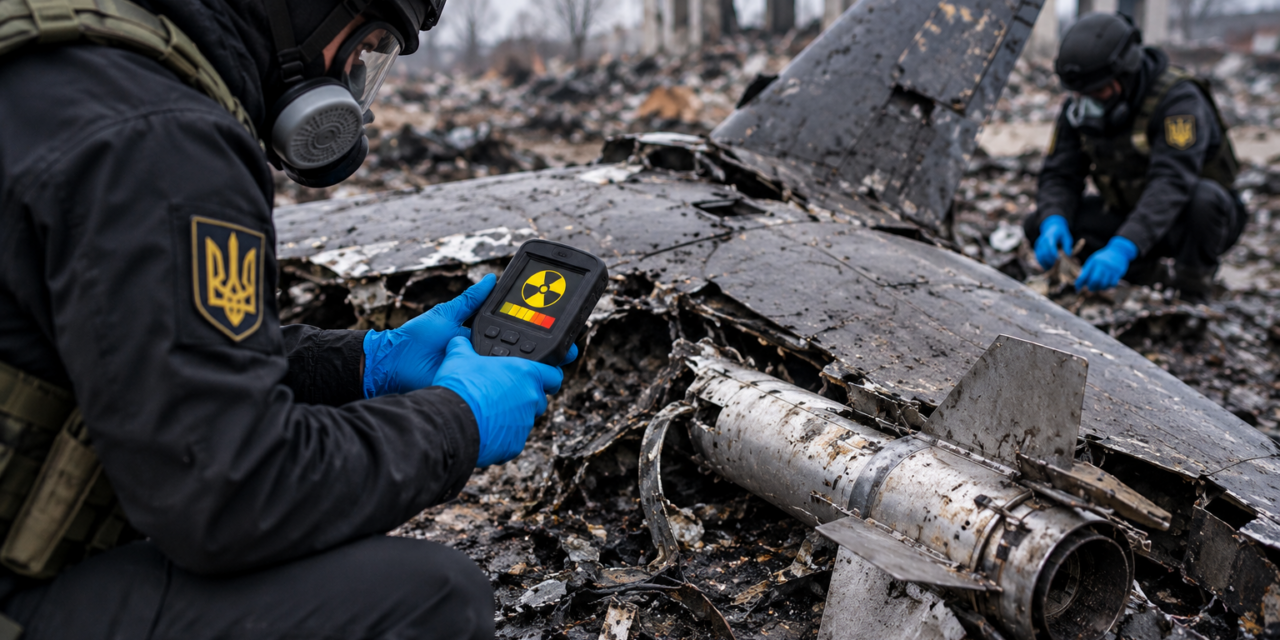
Ukraine’s Security Service (SBU) has reported the detection of elevated radiation levels on the wreckage of a Russian strike drone used in an attack on the Chernihiv region in April 2026. Investigators uncovered fragments of an air-to-air missile mounted on the modified UAV.
According to the SBU, counterintelligence officers and investigators examined debris from a modified Russian Geran-2 drone following the April 7 attack near the village of Kamka. The wreckage included parts of an R-60 air-to-air missile, believed to have been installed by Russian forces on the drone.
Ukrainian officials claim that Russia has been deploying such missiles during mass drone attacks to threaten Ukrainian aircraft and helicopters intercepting incoming UAVs. During radiation reconnaissance near the wreckage, specialists recorded gamma radiation levels of 12 microsieverts per hour, significantly above natural background levels and potentially hazardous to human health.
The SBU stated that emergency crews, in collaboration with Ukraine’s State Emergency Service and Armed Forces, secured the missile warhead and transported the radioactive materials to a designated storage site. Further examination revealed that the missile’s warhead contained depleted uranium, with striking elements identified as Uranium-235 and Uranium-238.
The SBU has warned civilians to exercise caution if they encounter fragments of drones, missiles, or other munitions. Damaged or burned ammunition poses the greatest risk, as it may release radioactive dust harmful to people and the environment. Authorities have urged residents not to approach, touch, or move suspicious debris and to report such findings to emergency services immediately.
Ukrainian specialists noted that the R-60M missile differs from the older R-60 model partly due to its warhead’s use of depleted uranium rods instead of tungsten. The R-60M can be identified by the radiation hazard marking on its warhead section.
This incident is not the first time Russia has posed a radiation threat to Ukraine. Earlier reports indicated that the structural stability of the shelter over Reactor 4 at the Chornobyl Nuclear Power Plant came under renewed scrutiny after damage from a Russian drone strike in February 2025, raising concerns about the long-term containment of radioactive materials.
Read more at united24media.com