

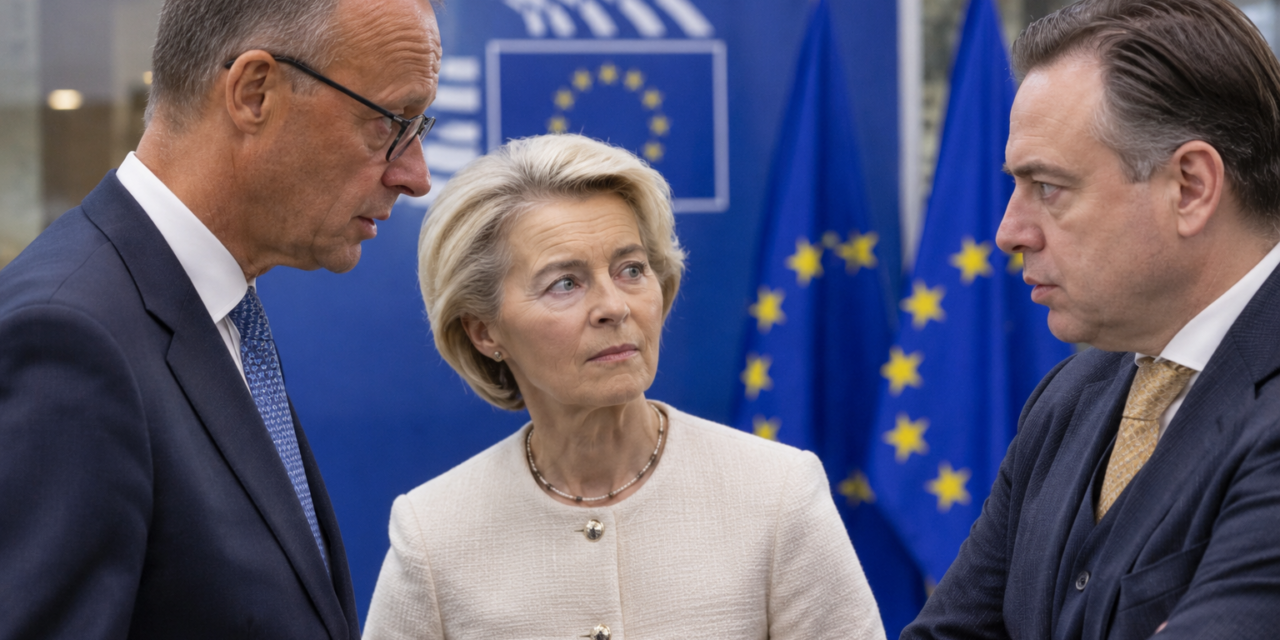
German Chancellor Friedrich Merz has cancelled a trip to Norway and is heading to Brussels to try to break the deadlock over an EU plan to fund Ukraine with frozen Russian assets. On Friday, December 5, 2025, he is due to meet Belgian Prime Minister Bart De Wever and European Commission President Ursula von der Leyen over a private dinner, aiming to win Belgium’s support for a so-called reparations loan.
The reparations loan
Under the European Commission’s proposal, the immobilized assets of Russia’s Central Bank would be turned into a zero-interest loan for Ukraine, which Kyiv would only have to repay once Moscow agrees to compensate for the damage caused by its war. Most of the assets, about €185 billion, are held at Euroclear, a securities depository based in Brussels, with another €25 billion elsewhere in the EU. Politico reported the loan could be worth up to €165 billion.
Time is short. Ukraine’s foreign assistance is expected to run dry in the second quarter of 2026, and the Commission plans to start payments then. EU leaders are due to make a final decision at a summit on December 18.
Belgium’s objections
De Wever has been the main obstacle. In a letter to von der Leyen, he called the plan “fundamentally wrong” and warned of “multifold dangers” that could leave Belgium and Euroclear facing multi-billion-euro losses if Russia retaliates. He said he would “never commit Belgium to sustain on its own the risks and exposures,” and told Belgium’s parliament the proposal “cannot count on the approval” of his government.
Belgium wants guarantees that can be paid out at any time and insists that other EU institutions holding Russian assets meet the same standards as Euroclear. De Wever has also argued that moving too fast could undermine US efforts to broker a peace deal.
Merz: share the risk
In an op-ed, Merz said the financial risks should be “shared collectively,” with each member state bearing a share in line with its economic strength, and that it would be “unacceptable for any single country to bear a disproportionate burden.” He said he understood Belgium’s concerns. The Commission has offered guarantees including contributions from member states, a backstop from the EU budget and protection against legal retaliation. If Belgium cannot be won over, the EU may have to raise €90 billion through joint borrowing instead.
Sources
Image note: The featured image was generated by AI based on the content of this article. It is an illustration, not an actual photograph of the people, places or events described.