
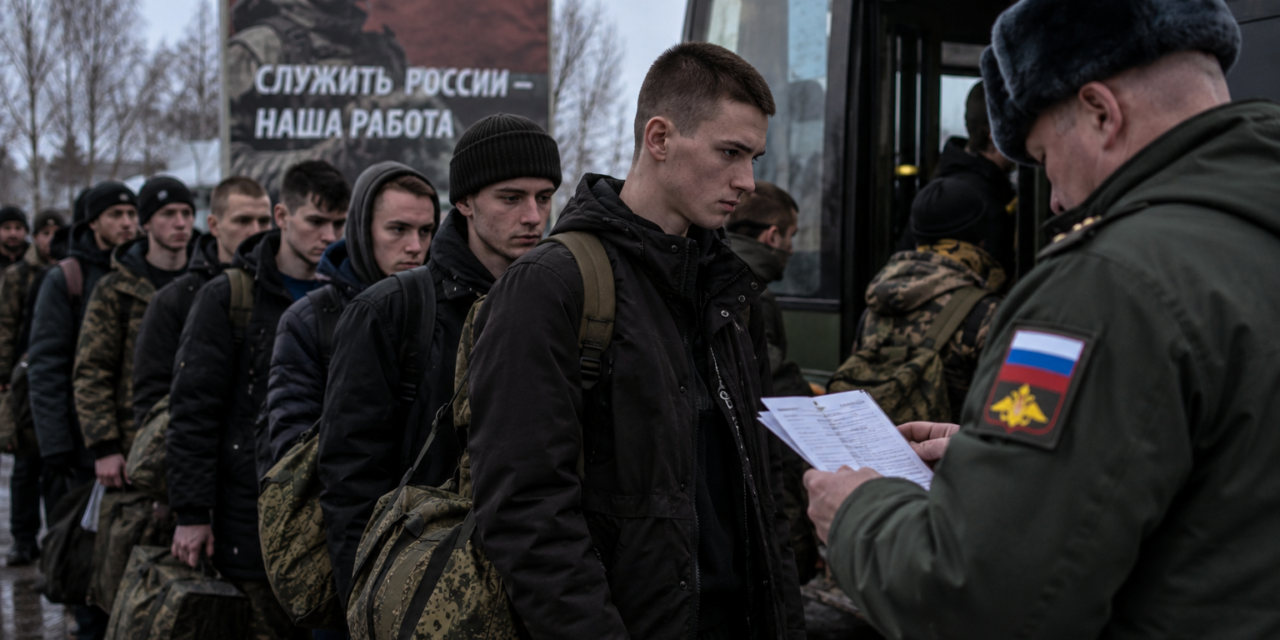
As Russia grapples with dwindling enlistments and mounting battlefield losses, experts suggest the Kremlin may be forced to consider a politically perilous draft expansion. The ongoing conflict with Ukraine has seen Russian recruitment efforts falter, prompting warnings from Kyiv about a potential forced mobilization by Moscow.
Kyiv claims that Russia is preparing to call up tens of thousands of new soldiers to compensate for its increasing battlefield casualties. However, analysts believe such a move would only occur if Russia faces an imminent front-line collapse or a significant shift to a war economy, potentially extending the conflict beyond Ukraine’s borders.
The initial wave of partial mobilization in September 2022 sparked protests and led to a mass exodus of Russians fleeing abroad. Despite this, the regime managed to endure the backlash. Now, with a war-weary economy and growing public fatigue, a second wave could be much harder to manage.
Max Bergmann, an analyst at the Center for Strategic and International Studies, notes that a new mobilization would indicate the regime’s immense strain and political entrapment. The 2022 mobilization of 300,000 reservists followed Ukraine’s successful counteroffensives, forcing the Russian public to confront the war’s long-term implications.
Despite the Kremlin’s declaration that the unpopular draft ended in November, no official decree canceled it. To avoid political fallout, especially in economic hubs like Moscow and St. Petersburg, the Kremlin has relied on contract soldiers, offering substantial financial incentives.
However, the recruitment of convicts and coercive tactics targeting migrants and ethnic minorities may not suffice to meet Russia’s military needs. A January report from the Center for Strategic and International Studies estimated around 1.2 million Russian battlefield casualties by December 2025, necessitating the recruitment of over 30,000 new troops monthly.
Ukrainian intelligence reported that approximately 70,500 new Russian soldiers signed contracts in early 2026, falling short of the Russian Defense Ministry’s target by about 30,000. Janis Kluge, a Russia expert, provided similar figures, highlighting a decline in recruitment rates despite increased financial incentives.
To address its manpower shortage, Russia may need to conduct at least a partial mobilization, according to Kateryna Stepanenko, a Russia analyst. The Kremlin is also increasing coercion to fill its ranks, pressuring students and setting recruitment quotas for businesses.
Despite these efforts, political barriers may prevent a new draft. The public backlash from the 2022 mobilization was significant but not enough to threaten the regime. However, as of mid-2026, public sentiment has shifted due to wartime inflation, increased taxes, and internet restrictions.
Analysts suggest that a new mobilization would be a risky move, especially with upcoming State Duma elections. Even if a new draft were declared, it might not quickly alter the battlefield dynamics, as Ukraine gains an edge in drone warfare.
Ultimately, a mobilization is likely only if Russia faces a crisis on the front lines or decides to escalate the war to a new level. Both scenarios are considered unlikely by experts, with the Kremlin’s current strategy focused on maintaining the status quo.
Pour en savoir plus kyivindependent.com





 French
  English
  Ukrainian
  German
  Spanish
  Chinese