
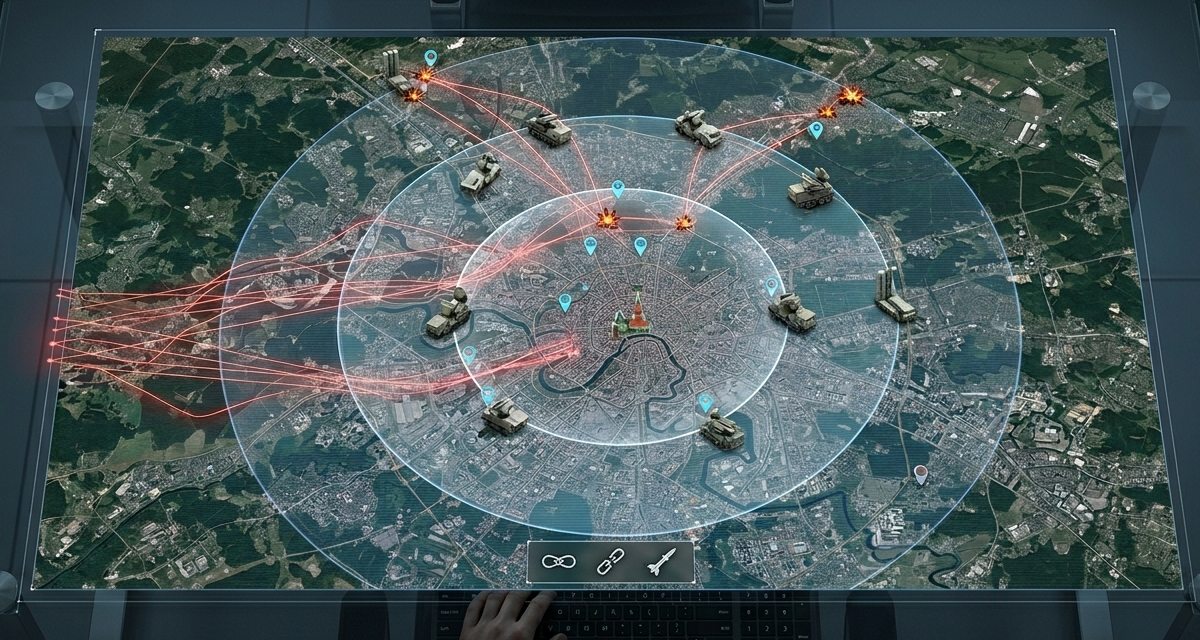
Ukraine has discovered a method to penetrate the complex air-defense systems surrounding Moscow, which includes at least 100 major defense positions, predominantly equipped with Pantsir systems centered around key ministry buildings. Military analyst Ivan Stupak suggests that Ukrainian strategies exploit blind spots within these defenses, marking a shift from isolated attacks to repeatable strategies. These exploits, while seemingly undermined by Russia’s dense air-defense network, are leveraged through advanced intelligence and tactical planning.
Stupak points out the growing frequency of attacks, predicting their escalation due to Ukraine’s detailed understanding and mapping of the defense rings. Open-source intelligence adds that around 130 air-defense positions are spread in various layers near Moscow, confirming that Ukrainian drones have surpassed at least three of these rings. Among the Ukrainian targets are critical infrastructure like the petroleum supply pipeline and the microelectronics plant in Zelenograd, pivotal for military components. Attacks on such facilities, while not always successful, disturb and potentially weaken Russian production capabilities.
These strategies are part of a broader psychological campaign by Ukraine to bring the realities of war closer to the Russian capital, disrupting the sense of safety historically held by Moscow’s inhabitants. Stupak emphasizes that the psychological impact of these attacks—creating unease among residents and skepticism among business circles—may lead to long-term strategic advantages for Ukraine.
Despite the potential for increased domestic discontent, the official Russian response remains subdued, with limited coverage on central TV channels. Stupak describes this reaction as a form of denial, suggesting that the Russian government is attempting to minimize the impact and visibility of such strikes, a tactic independently corroborated by Russian media analyses.
Джерело: Euromaidan Press




 Ukrainian
  English
  French
  German
  Spanish
  Chinese